
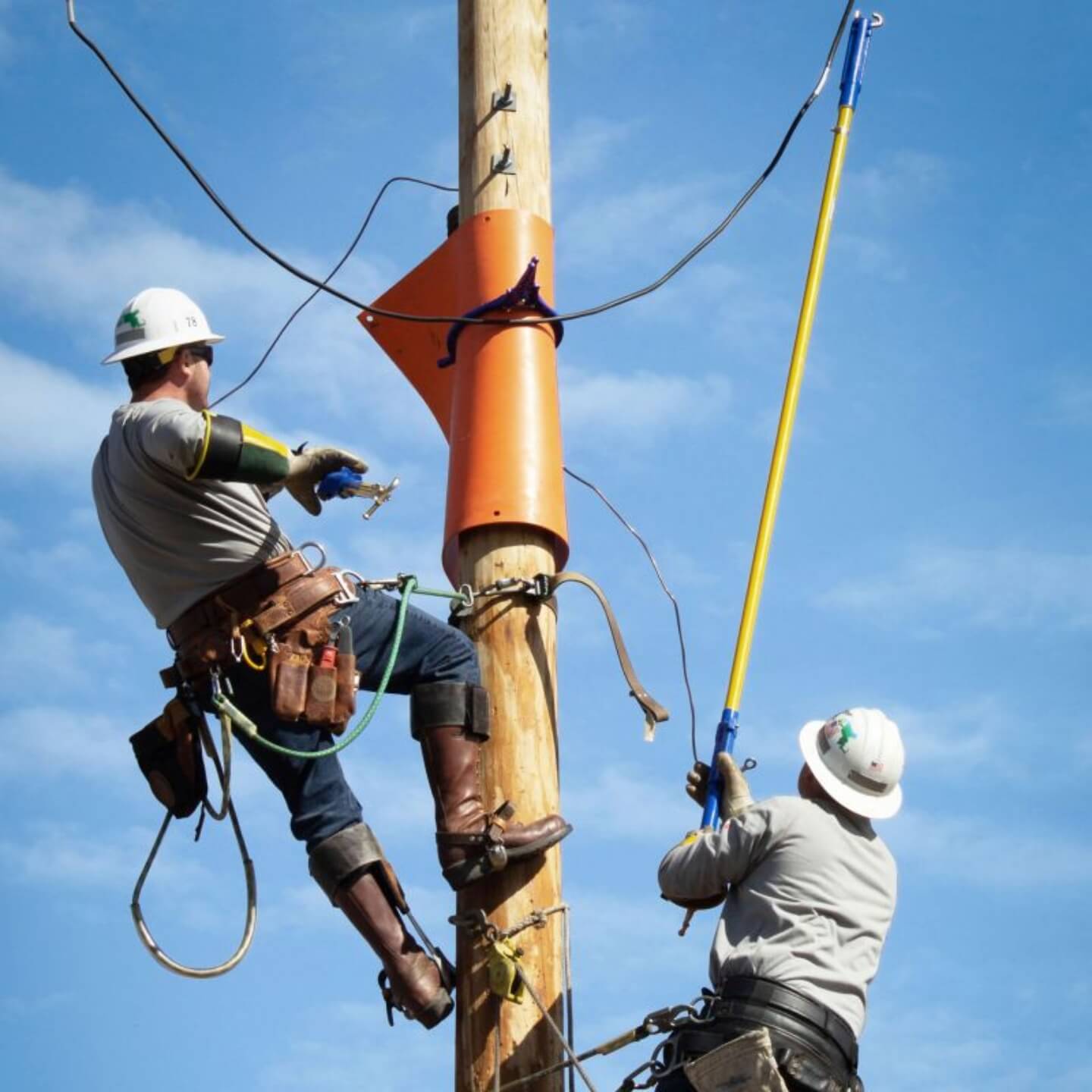
Hot sticks are an essential piece of equipment for lineworkers servicing high-voltage power lines. These insulated tools may look simple, but they provide a critical defense against electric shock and help crews perform live-line work from a safer distance.
This article explains what a hot stick is, outlines the main types of hot sticks used in the field, and covers the maintenance and safety considerations that make these tools so important in overhead and substation applications.
What Is a Hot Stick?
A hot stick, sometimes called a safety stick, is an insulated pole with a tool or attachment on the end that allows lineworkers to perform repairs, maintenance, and installations on energized lines while staying farther away from the hazard. In most cases, hot sticks are made from fiberglass because fiberglass offers strong insulating performance along with the mechanical strength needed for utility work.
With a standard universal end design, many hot sticks can be paired with a range of attachments depending on the task. The most important use of a hot stick is to help protect crews from electric shock, arc exposure, and related hazards during energized line work.
Hot Stick Safety Standards
Safety is not optional when crews are working on energized equipment. Hot sticks used for primary protection need to meet recognized standards so lineworkers are not exposed to unnecessary risk in the field.
Any hot stick a crew uses should meet or exceed ASTM F711 requirements for fiberglass-insulated live-line tools. OSHA requirements also matter, including maintaining the proper minimum approach distance for the voltage and work condition involved. Together, these standards help establish the inspection, handling, and performance expectations that support safer line work.
How Do Hot Sticks Work?
Hot sticks are designed with insulated fiberglass to provide a non-conductive barrier between the worker and the energized line or component being handled. Many designs also use closed-cell foam filling to help resist moisture intrusion and support the tool’s insulating properties over time.
Because the stick creates distance between the worker and the electrical source, crews can perform live-line maintenance, switching, testing, and handling tasks more safely than they could with direct contact. Many hot sticks also accept modular attachments such as hooks, prongs, and other tool heads that expand what one insulated stick can do in the field.
What Is a Hot Stick Used For?
Hot sticks are used across electrical distribution and transmission work wherever energized equipment must be handled, tested, or operated from a safer distance. Their range of lengths, attachment styles, and tool configurations makes them versatile for both routine and specialized work.
Common hot stick applications include:
- Repairs and maintenance on medium- and high-voltage energized equipment
- Overhead line attachment work
- Remote switching operations
- Safety ground applications
- Measuring and distance gauging
- Heavy-duty substation applications
Types of Hot Sticks
Hot sticks generally fall into three broad categories: straight hot sticks, telescoping hot sticks, and shotgun hot sticks. Each serves a different purpose depending on the reach, control, and attachment style needed for the job.
Universal Straight Hot Sticks
Straight hot sticks are among the most basic and widely used styles. They use a rigid, non-adjustable fiberglass body and are commonly chosen when crews want strong structural integrity for operating disconnects, replacing fuses, securing fasteners, or handling other routine field tasks.
Because they do not collapse or extend, straight hot sticks are often a solid choice when consistency, simplicity, and dependable handling matter most.
Telescoping Hot Sticks
Telescoping hot sticks use collapsible sections that allow the user to extend or retract the tool as needed. This gives crews flexibility when working on equipment at different heights while carrying fewer dedicated stick lengths into the field.
Telescoping designs are also commonly used for measuring applications because the expandable sections make it easier to gauge distance and reach in energized work environments.
Shotgun Hot Sticks
Shotgun hot sticks use a sliding mechanism to extend the tool to the desired length. Many also include a trigger-operated end mechanism that allows the user to grip, hook, or manipulate conductors and components with more control.
This style is often selected when crews need a combination of extended reach and positive handling for switching or conductor-related tasks.
Hot Stick Maintenance
Regular inspection, cleaning, and testing are essential to hot stick safety. Physical damage, contamination, or worn surface protection can affect the insulating performance of a fiberglass stick and create serious jobsite risk.
According to OSHA 1910.269(j), hot stick maintenance should include:
- Daily cleaning
- Inspection for cracks before use
- Formal inspection, maintenance, and testing every two years
- Ongoing personnel training
To clean a hot stick, crews should remove surface contamination with a clean, dry cloth and use appropriate approved maintenance products as part of their inspection and care program. Protective waxes or sealants are commonly used to help maintain surface condition and dielectric performance.
BLUE STRIPE Innovative Safety Solutions
Advances in hot stick design have improved both safety and productivity in live-line work. Utility Solutions BLUE STRIPE hot sticks are manufactured using electrical-grade fiberglass and closed-cell foam construction to support dielectric strength and mechanical durability in the field.
The BLUE STRIPE line includes a range of sizes, lengths, and attachment combinations to support different utility applications. That makes it easier for crews to match the tool to the task instead of forcing one configuration into every job.
Our BLUE STRIPE Hot Sticks
Utility Solutions offers straight, telescoping, and shotgun hot sticks, along with a broad range of hot stick attachments designed for universal spline ends. These tools are built for work on energized power lines and in substation environments where crews need dependable insulated performance and practical field handling.
Our fiberglass sticks are manufactured in the USA and are designed to support the safety and performance expectations crews have for line construction, maintenance, and repair work.
The Hot Sticks Linemen Want to Use
Since 1990, Utility Solutions has designed and manufactured hot line tools intended to emphasize safety, field performance, and practical use. Our hot sticks are built with lineworkers in mind, combining ergonomic handling with durable fiberglass construction suited for demanding utility environments.
For more information, explore Utility Solutions products through the website resources and product catalog.
Frequently Asked Questions About Hot Sticks
What defects during a daily hot stick inspection require immediate removal from service?
Any cracks or splits in the surface of a hot stick can significantly reduce its ability to protect against electric shock. Each stick should be inspected carefully before use, and any stick with visible cracking should be removed from service immediately.
What does fiber fraying on a fiberglass hot stick indicate, and what repair is required?
Visible fiberglass fibers or “hairs” on the surface usually indicate that the protective outer finish has worn down enough to expose the fiberglass beneath it. That can allow moisture and contaminants to affect the stick’s insulating performance. A stick in that condition should be removed from service and evaluated for proper repair, refinishing, or replacement.
Does a hot stick have to leave the field to satisfy OSHA’s two-year examination requirement?
Yes. OSHA 1910.269(j)(2)(iii) requires live-line tools used for primary employee protection to be removed from service every two years for examination, cleaning, repair, and testing.